Sarees
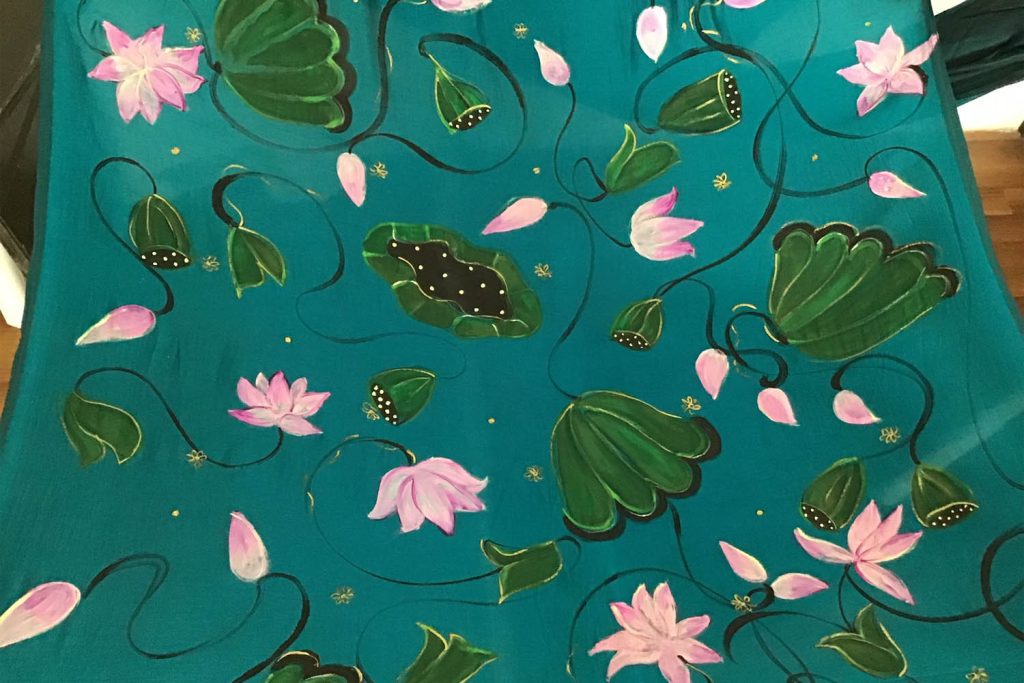
The brief: A boutique sari label asked us to hand-letter a short Sanskrit verse in Devanagari Lipi along the pallu of a small launch collection — twelve sarees in undyed tussar — without any of the calligraphy being printed, embroidered or stencilled.
Project context
The label’s founder had grown up watching her grandmother copy Sanskrit shlokas onto the borders of family heirlooms with a fountain pen. She wanted to build a launch collection around that memory rather than around a digitally repeated motif. Devanagari Lipi was the only script in the running — the verse came from a household prayer the family had recited for decades, and the founder was clear that screen-printing it would feel like fluorescent lighting in a room meant for diyas. The constraint was that the lettering had to sit directly on tussar silk, which is unforgiving. Tussar drinks ink unevenly along the grain, and the slubs in the weave catch any nib that hesitates. Twelve sarees, twelve identical verses, no two allowed to look photocopied.
Materials and craft choices
- Surface: undyed tussar silk, pre-washed twice in plain water and ironed at low heat to relax the slubs
- Ink: heat-set fabric ink mixed with a touch of acrylic flow improver; tested on an offcut for forty-eight hours before any saree was touched
- Nib: bamboo pen cut wide for the body of the akshara, plus a fine pointed nib for the matra strokes above the line
- Script: Devanagari Lipi
- Embellishment: none — the founder asked specifically for no gilding or sequin work, so the lettering itself had to carry the piece
Process
We started by writing the verse a hundred times on cotton calico to learn how our chosen ink behaved under different humidity. Tussar is more humid than calico because of the silk’s natural oil, so we adjusted the ink viscosity twice before the first saree was lettered. Each piece took roughly four hours of writing time, including pauses to let the ink set before we moved the fabric. We hung each saree vertically over a padded frame — laying it flat would have let the ink pool — and worked on the pallu from a slight angle so gravity helped the strokes finish cleanly. The twelfth piece was the most difficult; by then we had developed a hand memory for the verse, and small unintentional flourishes had to be consciously suppressed so the collection stayed visually consistent.
“Devanagari on silk teaches you that the head-line is not a rule — it is a horizon, and the silk decides where it lands.”
What we learned
Devanagari has a distinctive top bar — the shirorekha — that ties every akshara to the same horizontal line. On paper that line is a ruler; on tussar it has to be drawn with the weave’s permission. We learned to follow the dominant warp thread for two or three centimetres at a stretch before lifting the pen, and to accept that the bar would rise and fall by half a millimetre across a long verse. That small breathing was what made each saree look hand-lettered rather than transferred.
Script: Devanagari Lipi · Category: Clothing · Year: 2025
Have a project that needs hand calligraphy at this depth? Send us a brief or WhatsApp +91 98111 77262.
About this collection
We offer a range of plain sarees on which we customise and write your chosen words. It could be the lyrics of a song that resonate with you, or an unforgettable quote; the words of a friend or family member, or simply something you read. Beautifully inscribed on the saree, they add value to your look and embellish the entire ensemble. If you already own a saree you would like to enhance, you may bring that one to us too. Likhawat lets you brighten possessions with art and customisation — there are no boundaries on language or content. We hand-calligraph in nine languages: Hindi, Urdu, Persian, Bangla, Gurmukhi, English, French, Marathi and Gujarati. Each article is accompanied by artworks in a range of colours that add a personal touch and an edge of glory. Wash-care instructions differ by fabric and paint.
May 9, 2026