Canvas Art 7 languages – Hindi, Urdu, Persian, Bangla, Gurmukhi, English & French
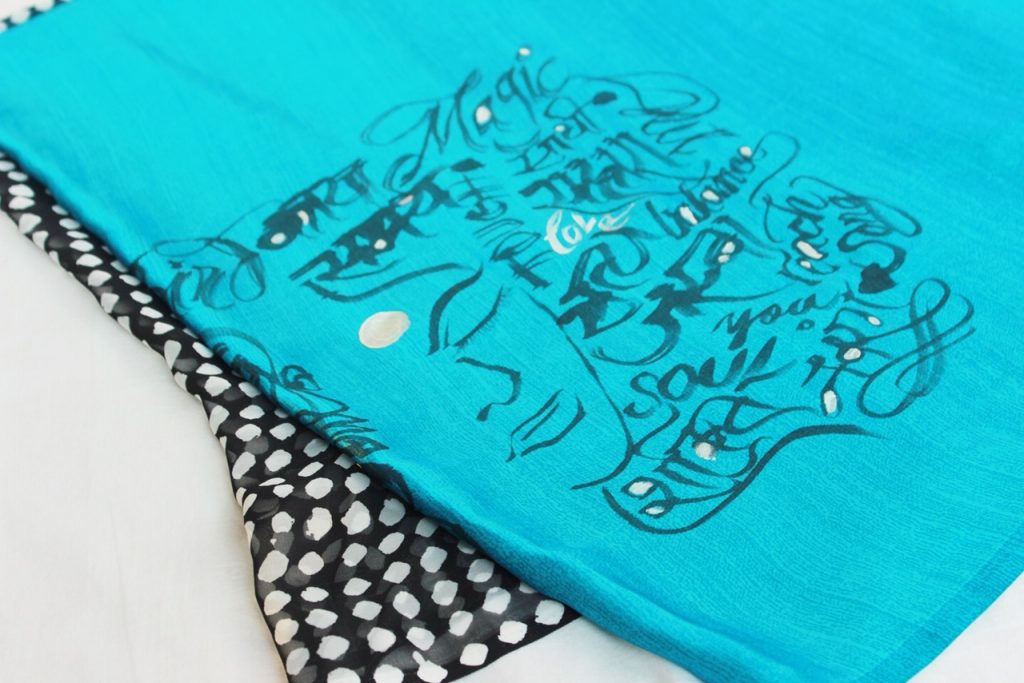
The brief: A publishing house preparing a touring exhibition on South Asian script heritage commissioned a single canvas that could carry the same sentence in seven languages — Hindi, Urdu, Persian, Bangla, Gurmukhi, English and French — without any one of them looking like a footnote to the others.
Project context
The exhibition’s curatorial argument was simple. The subcontinent has never been monolingual, and the modern habit of treating one script as the “main” script and the rest as decoration distorts how the region actually reads. Their request was a single artwork that put seven scripts on equal footing. We picked Urdu nastaliq as the gravitational centre of the piece because nastaliq carries the longest unbroken calligraphic lineage of the seven and because its sloping baseline gives the eye somewhere to rest while it travels across less familiar shapes. Print would have flattened the differences; hand calligraphy let every stroke carry the weight of its own tradition, including the curves of Bangla, the sharp shoulders of Gurmukhi and the open loops of cursive French.
Materials and craft choices
- Surface: Belgian linen canvas, 12 oz, primed with three coats of titanium gesso sanded between each
- Ink: iron-gall for the nastaliq passage, sumi black for the Devanagari and Bangla, walnut ink for the Latin scripts
- Nib: qalam reed cut to 4 mm for nastaliq; broad-edge metal nibs for Devanagari, Bangla and Gurmukhi; Brause oblique for the English and French
- Script: Urdu Nastaliq lead with a six-script supporting suite
- Embellishment: a single sheet of palladium leaf laid behind the nastaliq line to lift it without warming the palette
Process
We spent the first ten days not writing at all. The studio worked with a paleographer and three native readers — one for Bangla, one for Gurmukhi, one for Persian — to confirm proportion and ligature choices that a non-native hand would have got subtly wrong. Once the layout was locked, we wrote each script on tracing paper at full canvas scale, then assembled them into a single composition before transferring to linen. Iron-gall ink sits differently on primed linen than on paper; it bites slower and reads cooler, so the nastaliq line, written first, set the colour temperature for everything else. We deliberately kept the seven blocks the same vertical height so no script appeared dominant. The eye reads the canvas as one sentence in seven voices, not as a translation hierarchy.
“The hardest part of writing seven scripts on one canvas is making sure none of them apologises for being there.”
What we learned
Multi-script work asks a calligrapher to abandon two reflexes — the reflex to centre the script you know best, and the reflex to make every line behave like the one before it. We learned to let nastaliq tilt, Devanagari sit flat and Gurmukhi step forward without forcing them onto a shared baseline. We also learned that palladium leaf reads cooler than gold under exhibition lighting; for any future multi-script piece destined for gallery walls, palladium is the better choice unless the brief specifically asks for warmth.
Script: Urdu Nastaliq · Category: Art Work · Year: 2024
Have a project that needs hand calligraphy at this depth? Send us a brief or WhatsApp +91 98111 77262.
About this collection
Canvas art across seven languages — Hindi, Urdu, Persian, Bangla, Gurmukhi, English and French. Each piece is hand-lettered at the studio and finished as an original artwork; the language and the script are part of the composition, not a label on it. Ideal for collectors, language-loving readers and bilingual homes.
May 9, 2026